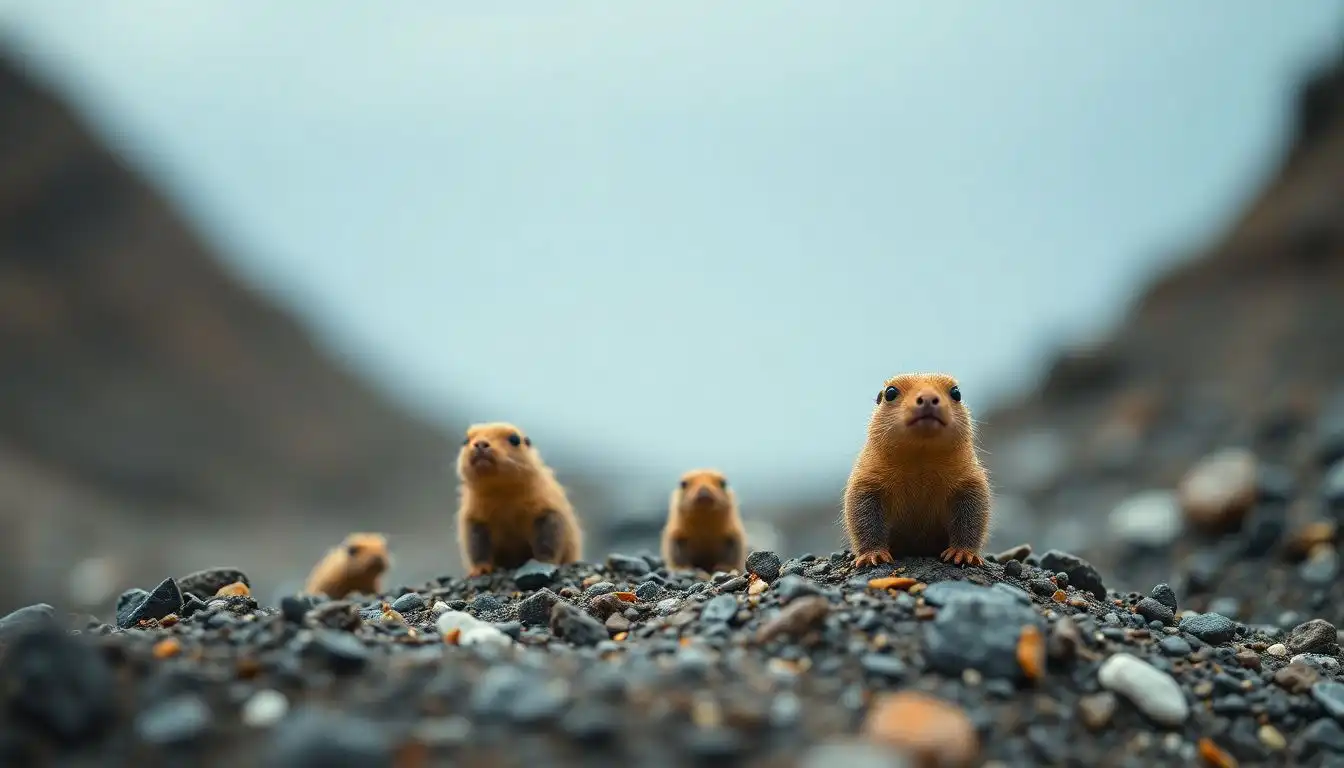
43 Years Ago, Scientists Dropped Gophers Onto a Volcano: This unusual experiment began as a desperate attempt to jumpstart life in a wasteland. What followed was a masterclass in nature’s resilience, proving that even the humblest creatures can reshape an entire ecosystem.
In the early 1980s, the landscape surrounding Mount St. Helens looked more like the surface of the moon than a lush forest. A massive volcanic eruption had obliterated everything in its path, leaving behind a thick layer of grey ash and scorched earth.
Scientists were baffled by how slowly the land was recovering, until they decided to enlist some unlikely local residents. By dropping northern pocket gophers into the blast zone for just one day, they triggered a biological revolution that is still yielding results four decades later.
The Day the Mountain Blew and Everything Died
When the volcano erupted in 1980, the sheer force of the blast flattened millions of trees and buried the soil under metres of hot, sterile pumice. It was a total wipeout, leaving no seeds, no insects, and certainly no greenery.
- I bought my grandparents’ house and lived next to my mom. When she decided to move, it was hard on both of us.
- Rent Assistance for Pensioners Climbs to $188.20 per Fortnight in 1 April 2026
- Psychology says the reason most people never change their lives isn’t fear of failure – it’s that they’ve spent so long performing a version of themselves for other people that they genuinely can’t tell anymore which desires are actually theirs
- Psychology says the parents whose adult children gradually stop visiting aren’t usually the ones who were cruel or absent — they’re often the ones so focused on providing and protecting that they never learned to simply be company, and children grow up moving towards the people they feel easy with rather than the people they owe the most to
- Iran Strikes Australian Airbase as Gulf Attacks Escalate: Growing Tensions in the Region
Biologists concerned with land recovery noticed that the “top” layer of the earth was now essentially glass and crushed rock. Nothing could grow because the nutritious topsoil was trapped deep beneath this new, suffocating blanket of volcanic debris.
While the scenery was spectacular in a grim way, the lack of life was haunting. For two years, the area remained a grey desert, leading researchers to wonder if the forest would ever return within their lifetimes.
An Unconventional Experiment with Furry Diggers
In 1982, a team of researchers decided to test a wild theory involving biopedturbation—the fancy term for animals moving soil around. They hitched a ride on a helicopter, carrying several crates of pocket gophers.
The plan was simple: leave the animals in specific plots for about 24 hours and see what happened. They weren’t meant to live there permanently at first; they were just there to do what they do best: dig holes and flip the dirt.
- Psychologists say the bond between a person and the dog that sleeps in their bed isn’t comparable to human attachment. It’s actually more stable, because the dog never withdraws affection as punishment, never keeps score, and never makes closeness conditional on performance.
- Special Flight from Abu Dhabi Brings 101 Greeks & 45 Pets Home
- I’m 37 and I Just Realized I’ve Been Calling Myself an Introvert for Twenty Years When the Truth is I’m Just Exhausted From Spending My Entire Life Accommodating Other People’s Need for Constant Noise
- Psychology says people who grow apart from their family as they age aren’t cold or ungrateful – they’re often the ones who finally stopped performing a version of themselves that kept the peace but cost them their identity
- When someone is outwardly cheerful but still feels deeply alone, psychologists say these 10 quiet behaviors often reveal the disconnect
By placing these rodents on the ash, scientists hoped the animals would tunnel down and bring the old, nutrient-rich soil to the surface. It was a low-cost gamble that many sceptics thought would achieve very little against such a massive scale of destruction.
“The introduction of burrowing mammals into a primary successional environment serves as a catalyst for nutrient cycling. By physically mixing the sterile ash with buried organic matter, these animals create micro-habitats where seeds can finally take root and thrive.”
The Magic of the Gopher Mound
The results were almost instantaneous in geological terms. Within just a few years, the plots where the gophers had spent their “workday” were covered in vibrant patches of green, while the surrounding areas remained bleak and empty.
As the gophers dug, they didn’t just move dirt; they moved mycorrhizal fungi. These are microscopic fungi that attach to plant roots and help them absorb water and minerals—essential for survival in a harsh, dry volcanic field.
- Centrelink Digital Payment System From 1 April 2026: Faster Benefit Deposits For Australians
- Disability Pension Supplements of $1,600 Paid Before 1 April 2026 Nationwide
- I worked for 42 years, retired with more money than I ever imagined having, and by the third Wednesday of my new life I was reorganizing the garage at 10 a.m. just to feel like someone still expected something from me
- Psychology says the quiet rage many older men carry isn’t bitterness, it’s the accumulation of decades where expressing vulnerability would have cost them everything — their authority, their marriages, their self-respect — so they stored it as anger because anger was the only emotion their generation allowed men to keep
- Goodbye to Low Pension Payments: Australians Could Receive Over $1,178 From 1 April 2026
Each mound of dirt a gopher pushed to the surface acted like a starter kit for life. Seeds blown in by the wind found a soft, nutrient-dense place to land, allowing the first wild lupines and grasses to establish a foothold.
Comparing Life Without Gophers
To understand just how much of an impact these tiny animals had, it helps to look at the numbers. The difference between the “gopher-assisted” zones and the untouched ash was staggering.
| Feature | Untouched Ash Zones | Gopher-Worked Zones |
|---|---|---|
| Plant Species Diversity | Low (1-2 types) | High (Over 20 types) |
| Fungal Presence | Near Zero | Abundant Mycorrhizae |
| Soil Texture | Hard, Crusty Pumice | Loamy, Aerated Mix |
| Recovery Speed | Decades to Centuries | Rapid (within 5-10 years) |
From Pests to Ecological Powerhouses
In many parts of the world, including rural parts of Australia where similar burrowing creatures reside, these animals are often seen as a nuisance. They ruin lawns and can be a headache for farmers concerned about their livestock stepping into holes.
However, the Mount St. Helens experiment flipped this narrative on its head. It showed that “disturbing” the ground is actually a vital service for the planet, especially after a natural disaster has wiped the slate clean.
- I bought my grandparents’ house and lived next to my mom. When she decided to move, it was hard on both of us.
- Rent Assistance for Pensioners Climbs to $188.20 per Fortnight in 1 April 2026
- Psychology says the reason most people never change their lives isn’t fear of failure – it’s that they’ve spent so long performing a version of themselves for other people that they genuinely can’t tell anymore which desires are actually theirs
- Psychology says the parents whose adult children gradually stop visiting aren’t usually the ones who were cruel or absent — they’re often the ones so focused on providing and protecting that they never learned to simply be company, and children grow up moving towards the people they feel easy with rather than the people they owe the most to
- Iran Strikes Australian Airbase as Gulf Attacks Escalate: Growing Tensions in the Region
These rodents are essentially nature’s rotary hoes. Without their constant churning of the earth, the forest would have taken many more decades, perhaps even centuries, to reach the level of maturity it displays today.
“We often underestimate the role of small mammals in forest regeneration. Their ability to transport spores and nitrogen-fixing bacteria through the soil profile is more effective than most artificial reclamation efforts currently available to us.”
The Long-Term Legacy of the 1982 Drop
Forty-three years later, the impact of that single day in 1982 is still visible to those who know where to look. The patches of forest that grew from those original gopher mounds are now thick with conifers and diverse wildlife.
Birds, insects, and larger mammals like elk eventually followed the greenery. The gophers created the “islands” of life that eventually merged together to form a cohesive, functioning ecosystem.
- Psychologists say the bond between a person and the dog that sleeps in their bed isn’t comparable to human attachment. It’s actually more stable, because the dog never withdraws affection as punishment, never keeps score, and never makes closeness conditional on performance.
- Special Flight from Abu Dhabi Brings 101 Greeks & 45 Pets Home
- I’m 37 and I Just Realized I’ve Been Calling Myself an Introvert for Twenty Years When the Truth is I’m Just Exhausted From Spending My Entire Life Accommodating Other People’s Need for Constant Noise
- Psychology says people who grow apart from their family as they age aren’t cold or ungrateful – they’re often the ones who finally stopped performing a version of themselves that kept the peace but cost them their identity
- When someone is outwardly cheerful but still feels deeply alone, psychologists say these 10 quiet behaviors often reveal the disconnect
This experiment has changed the way land managers approach bushfire recovery and mine site rehabilitation. Instead of just planting trees and hoping for the best, there is now a focus on the health of the soil and the role of “ecosystem engineers” like burrowing animals.
Why This Matters for Australia
While we don’t have pocket gophers in Australia, we have our own versions of these tiny heroes. Animals like the bilby and the bettong perform almost identical roles in our bushland, turning over the soil and helping native seeds germinate after fires.
The lessons from the volcano are clear: protecting our native diggers is essential for the long-term health of our environment. When we lose these animals, the soil becomes compacted and nutrient-poor, making it much harder for the bush to bounce back after a crisis.
Investing in the conservation of these species is a bit like buying an insurance policy for the landscape. They do the hard work of gardening the planet for free, ensuring that life can return even after the most devastating events.
- Centrelink Digital Payment System From 1 April 2026: Faster Benefit Deposits For Australians
- Disability Pension Supplements of $1,600 Paid Before 1 April 2026 Nationwide
- I worked for 42 years, retired with more money than I ever imagined having, and by the third Wednesday of my new life I was reorganizing the garage at 10 a.m. just to feel like someone still expected something from me
- Psychology says the quiet rage many older men carry isn’t bitterness, it’s the accumulation of decades where expressing vulnerability would have cost them everything — their authority, their marriages, their self-respect — so they stored it as anger because anger was the only emotion their generation allowed men to keep
- Goodbye to Low Pension Payments: Australians Could Receive Over $1,178 From 1 April 2026
“The restoration of degraded landscapes depends heavily on the presence of soil-disturbing fauna. These creatures are the primary drivers of soil aeration and water infiltration in environments that would otherwise remain dormant and unproductive.”
A New Perspective on Biodiversity
We often focus on the big, charismatic animals like koalas or kangaroos, but the Mount St. Helens story reminds us to look under our feet. The tiny creatures we might usually ignore are sometimes the ones holding the whole system together.
The gophers didn’t know they were saving a forest; they were just looking for a snack and a place to hide. Yet, their simple, natural instincts were enough to overcome the devastation of a volcanic eruption.
As we face increasing environmental challenges, from record-breaking heatwaves to massive fires, looking back at this 43-year success story provides a glimmer of hope. Nature has a plan, and often, it involves a very small animal with very big claws.
- I bought my grandparents’ house and lived next to my mom. When she decided to move, it was hard on both of us.
- Rent Assistance for Pensioners Climbs to $188.20 per Fortnight in 1 April 2026
- Psychology says the reason most people never change their lives isn’t fear of failure – it’s that they’ve spent so long performing a version of themselves for other people that they genuinely can’t tell anymore which desires are actually theirs
- Psychology says the parents whose adult children gradually stop visiting aren’t usually the ones who were cruel or absent — they’re often the ones so focused on providing and protecting that they never learned to simply be company, and children grow up moving towards the people they feel easy with rather than the people they owe the most to
- Iran Strikes Australian Airbase as Gulf Attacks Escalate: Growing Tensions in the Region
FAQs – 43 Years Ago, Scientists Dropped Gophers Onto a Volcano
Why were gophers chosen for this experiment?
Scientists chose them because they are prolific diggers that naturally move underground soil to the surface. This “churning” effect was exactly what the sterile, ash-covered ground needed to regain its fertility.
Did the gophers stay on the volcano forever?
The original gophers were only left on the mountain for 24 hours to see if their digging would help. However, their short stint created the conditions that allowed other plants and animals to eventually return and stay for good.
How did the gophers help plants grow?
They brought buried seeds and beneficial fungi to the surface. These fungi are crucial because they help plant roots take in nutrients from the soil, which is particularly difficult in volcanic ash.
Does this mean we should put gophers everywhere?
Not necessarily. While they were heroes in this specific case, it is important to only use native species that belong in that specific environment. In Australia, we look to our own digging mammals to do the same job.
- Psychologists say the bond between a person and the dog that sleeps in their bed isn’t comparable to human attachment. It’s actually more stable, because the dog never withdraws affection as punishment, never keeps score, and never makes closeness conditional on performance.
- Special Flight from Abu Dhabi Brings 101 Greeks & 45 Pets Home
- I’m 37 and I Just Realized I’ve Been Calling Myself an Introvert for Twenty Years When the Truth is I’m Just Exhausted From Spending My Entire Life Accommodating Other People’s Need for Constant Noise
- Psychology says people who grow apart from their family as they age aren’t cold or ungrateful – they’re often the ones who finally stopped performing a version of themselves that kept the peace but cost them their identity
- When someone is outwardly cheerful but still feels deeply alone, psychologists say these 10 quiet behaviors often reveal the disconnect
What is the most important lesson from this study?
The main takeaway is that healthy soil is the foundation of all life. Animals that move and aerate the soil are vital for helping ecosystems recover after major disasters like eruptions or fires.