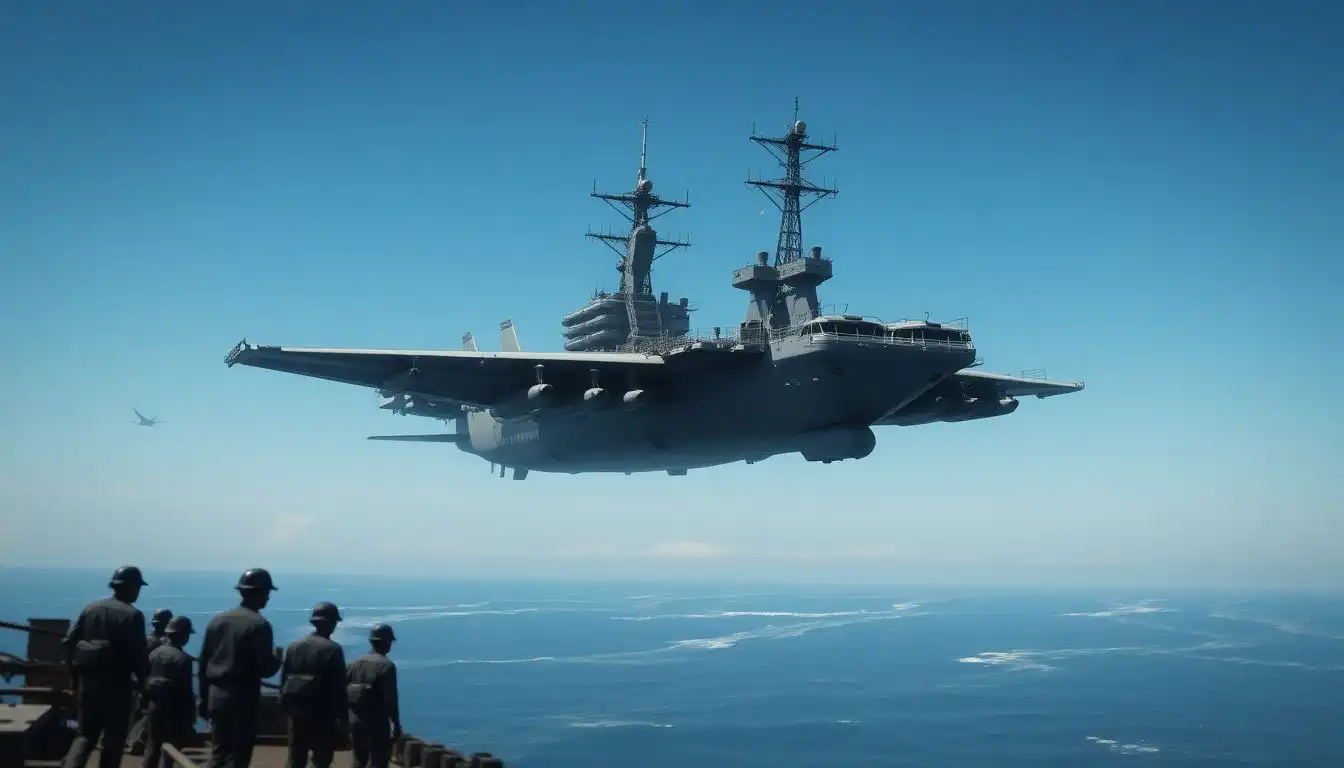
2 Aircraft Carriers Down, 1 Breaking Apart: The global military landscape has shifted overnight as the backbone of Western maritime power faces a nightmare scenario. For decades, the United States Navy has projected strength through its massive supercarriers, but a sustained conflict in the Middle East has pushed these steel giants to their absolute breaking point.
The reality on the water is grimmer than the official briefings suggest. With two aircraft carriers reportedly knocked out of action and a third suffering from catastrophic structural fatigue, the U.S. Navy is effectively running out of ways to enforce its will in the Persian Gulf and beyond. This crisis leaves a massive power vacuum that affects global trade routes and the security of allies like Australia.
For Aussie observers, the sight of a crippled American fleet is more than just a headline. Our own national security relies heavily on the “umbrella” of American naval supremacy. If the Pacific and the Indian Ocean lose their primary protectors, the ripple effects on fuel prices in Sydney and shipping lanes in the Coral Sea will be felt immediately by every household.
The Brutal Reality of Modern Naval Warfare
Modern missiles have changed the game for ships that cost billions of dollars to build. In the heat of the Iran War, high-tech drones and ballistic missiles have found their mark against targets once thought invincible. A single lucky hit can take a supercarrier out of the fight for months, if not years, given the complexity of their flight decks and nuclear reactors.
- I bought my grandparents’ house and lived next to my mom. When she decided to move, it was hard on both of us.
- If You Want To Find True Inner Peace, Start Saying “no” to These 8 Things
- I’m 65 and the most frightening thing about losing my joy wasn’t losing it — it was how long it took me to notice it was gone, like a light that dims so slowly you keep thinking the room is fine until one day you can’t read anything anymore
- Psychology says people who grow apart from their family as they age aren’t cold or ungrateful – they’re often the ones who finally stopped performing a version of themselves that kept the peace but cost them their identity
- Centrelink Digital Payment System From 1 April 2026: Faster Benefit Deposits For Australians
Maintenance cycles are being ignored to keep hulls in the water, leading to a dangerous decline in safety. When a ship is forced to stay at sea for double its intended deployment time, systems begin to fail. Internal plumbing, electrical grids, and even the structural integrity of the hull start to degrade under the salt and the strain.
“The relentless operational tempo in the Middle East has bypassed standard maintenance windows, leading to a systemic failure of critical onboard infrastructure. We are seeing structural fatigue that usually takes decades appearing in just a few short years of high-intensity combat.”
The U.S. Navy is now scrambling to find dry docks capable of handling these monsters. There are only a handful of facilities in the world that can repair a Nimitz-class or Ford-class carrier. With these docks already full, the damaged ships are sitting ducks, waiting for a spot that might not open up until the war is already over.
Why the Supercarriers Are Breaking Apart
It isn’t just enemy fire causing the issues; it is the physical toll of constant launches. The catapult systems on these ships are designed for a specific number of cycles. In a high-intensity conflict against Iran, these limits are being smashed daily. Metal fatigue in the catapult tracks can lead to “breaking apart” scenarios where the flight deck becomes a graveyard for expensive jets.
- Centrelink cash boost: Millions of Australians to receive Services Australia payment increase
- Disability Pension Supplements of $1,600 Paid Before 1 April 2026 Nationwide
- Tropical Cyclone Narelle Hits Far North Queensland: Residents Take Shelter as Storm Causes Destruction
- 3 New Thriller Movies to Watch on Netflix This Week (March 19–25)
- Psychology says the quiet rage many older men carry isn’t bitterness, it’s the accumulation of decades where expressing vulnerability would have cost them everything — their authority, their marriages, their self-respect — so they stored it as anger because anger was the only emotion their generation allowed men to keep
Personnel exhaustion is another silent killer of the fleet. Crews that should have been rotated back to San Diego or Norfolk are being told to stay in the fight. Human error increases when sailors are tired, leading to accidents that can be just as damaging as an Iranian suicide drone.
Estimated Status of the U.S. Carrier Fleet
| Carrier Name/Class | Current Operational Status | Primary Damage/Issue | Estimated Repair Time |
|---|---|---|---|
| USS Gerald R. Ford | Inactive | Major hull breach / Engine failure | 18–24 Months |
| USS Dwight D. Eisenhower | Critical Condition | Structural fatigue / Flight deck cracks | Unknown |
| USS Abraham Lincoln | Disabled | Missile strike / Electronic warfare damage | 12 Months |
| USS Ronald Reagan | Operational (Limited) | Overdue for refit | Scheduled for 2025 |
The Impact on Australia and the Indo-Pacific
The Royal Australian Navy has always operated under the assumption that the United States would provide the heavy lifting in any major regional spat. With three supercarriers effectively sidelined, the burden of patrolling the South China Sea falls onto smaller navies. This puts Canberra in a difficult position, as our Hobart-class destroyers are excellent but cannot replace the air power of a carrier.
Our trade routes are the lifeblood of the Australian economy. Everything from flat-screen TVs to the fuel that runs our utes comes through the very waters that are now less secure. If the U.S. Navy cannot spare a carrier to escort tankers, insurance premiums for shipping will skyrocket, adding hundreds of dollars to the cost of living for families in Melbourne and Brisbane.
“Australia faces a strategic nightmare if the American carrier fleet remains depleted. Without the psychological deterrent of a carrier strike group, regional actors may feel emboldened to close vital checkpoints, directly threatening the Australian supply chain.”
Also Read
- Rent Assistance for Pensioners Climbs to $188.20 per Fortnight in 1 April 2026
- Iran Strikes Australian Airbase as Gulf Attacks Escalate: Growing Tensions in the Region
- Special Flight from Abu Dhabi Brings 101 Greeks & 45 Pets Home
- I’m 37 and I Just Realized I’ve Been Calling Myself an Introvert for Twenty Years When the Truth is I’m Just Exhausted From Spending My Entire Life Accommodating Other People’s Need for Constant Noise
- Goodbye to Low Pension Payments: Australians Could Receive Over $1,178 From 1 April 2026
A New Era of Missile Diplomacy
The Iran War has proven that cheap technology can defeat expensive legacy systems. A Houthi or Iranian drone costing approximately $30,000 AUD can cause damage to a ship that costs $20 billion AUD to replace. This “asymmetric warfare” is the primary reason the U.S. Navy is struggling to maintain its presence in the region.
Defensive systems like the Phalanx CIWS or RIM-162 SeaSparrow are being depleted faster than তারা can be manufactured. Each time a carrier defends itself, it uses up munitions that take months to replace. Eventually, the magazine runs dry, leaving the ship vulnerable to a saturation attack where dozens of missiles are fired at once.
The Problems with the Ford-Class Design
The newest class of supercarriers was supposed to be the future, but they have been plagued by technical “glitches” since they left the shipyard. The Electromagnetic Aircraft Launch System (EMALS) has proven to be less reliable than the old steam catapults. Short circuits and software bugs have grounded entire air wings at the worst possible moments during the Iran War.
When these ships are “breaking apart,” it refers to the integration of these new technologies under combat stress. The vibration from near-miss explosions causes sensitive electronics to fail, turning a state-of-the-art warship into a floating piece of scrap metal. The U.S. Navy is finding that complexity is the enemy of reliability in a Middle Eastern climate.
- Psychology says the parents whose adult children gradually stop visiting aren’t usually the ones who were cruel or absent — they’re often the ones so focused on providing and protecting that they never learned to simply be company, and children grow up moving towards the people they feel easy with rather than the people they owe the most to
- Psychologists say the bond between a person and the dog that sleeps in their bed isn’t comparable to human attachment. It’s actually more stable, because the dog never withdraws affection as punishment, never keeps score, and never makes closeness conditional on performance.
- Low-Income Australians Eligible for $2,000 Relief as Applications Close 1 April 2026
- When someone is outwardly cheerful but still feels deeply alone, psychologists say these 10 quiet behaviors often reveal the disconnect
- Psychology says the reason most people never change their lives isn’t fear of failure – it’s that they’ve spent so long performing a version of themselves for other people that they genuinely can’t tell anymore which desires are actually theirs
“The push for total automation on the Ford-class has backfired in a high-intensity combat environment. When systems fail under fire, there are simply not enough sailors onboard to perform manual workarounds, leading to a total loss of mission capability.”
The Long Road to Recovery
Fixing this mess will take more than just money; it requires time that the Pentagon doesn’t have. It takes years to train the specialized welders and engineers needed to repair a nuclear-powered aircraft carrier. Many of these skills have been lost in the West as shipbuilding shifted to commercial hubs in Asia.
While the U.S. tries to rebuild, other powers are watching. The Chinese PLA Navy is currently launching its own carriers at a record pace. If the American fleet remains docked for repairs, the strategic balance of the 21st century could shift permanently toward the East. This leaves Australia at a crossroads, needing to decide if we must invest more heavily in our own sovereign defense capabilities rather than relying on a fading superpower.
FAQs – 2 Aircraft Carriers Down
How did the carriers get damaged in the Iran War?
Most of the damage has come from a combination of long-range ballistic missile strikes, coordinated drone swarms, and sheer mechanical exhaustion from staying at sea too long without maintenance. One carrier suffered a direct hit to its flight deck, while another experienced a massive internal engine failure due to structural stress.
- American Tourist Briefly Detained in Bali for Breaking ‘Day of Silence’ Rules
- $480 Medicare Safety Net Reset: New Threshold Applies From 1 April 2026
- I worked for 42 years, retired with more money than I ever imagined having, and by the third Wednesday of my new life I was reorganizing the garage at 10 a.m. just to feel like someone still expected something from me
- First‑Ever Camera Survey of Remote Tasmanian Island Reveals Rare and Elusive Wildlife
- 43 Years Ago, Scientists Dropped Gophers Onto a Volcano. Today, They’re Tiny Heroes.
Is the U.S. Navy still the strongest in the world?
Technically, yes, but its “availability” is at an all-time low. Having 11 carriers means nothing if half of them are in the shop and the others are too damaged to launch aircraft. The force is currently overstretched and unable to meet all its global commitments simultaneously.
How does this affect the price of goods in Australia?
When the U.S. Navy cannot protect shipping lanes, shipping companies have to take longer routes or pay massive insurance fees. These costs are passed on to consumers. Expect to see higher prices for fuel, electronics, and imported food if the naval crisis continues.
Can Australia help repair these ships?
While Australia has excellent naval facilities in Adelaide and Perth, we generally do not have the dry docks or the nuclear licensing required to repair U.S. supercarriers. We can help with smaller escort ships, but the big carriers must go back to the United States or specialized bases.
Are aircraft carriers becoming obsolete?
The Iran War suggests that carriers are much more vulnerable than previously thought. While they are still powerful tools for projecting air power, the rise of cheap, long-range missiles means they can no longer operate close to enemy shores with impunity.
- I bought my grandparents’ house and lived next to my mom. When she decided to move, it was hard on both of us.
- If You Want To Find True Inner Peace, Start Saying “no” to These 8 Things
- I’m 65 and the most frightening thing about losing my joy wasn’t losing it — it was how long it took me to notice it was gone, like a light that dims so slowly you keep thinking the room is fine until one day you can’t read anything anymore
- Psychology says people who grow apart from their family as they age aren’t cold or ungrateful – they’re often the ones who finally stopped performing a version of themselves that kept the peace but cost them their identity
- Centrelink Digital Payment System From 1 April 2026: Faster Benefit Deposits For Australians
What is meant by a carrier “breaking apart”?
This refers to structural metal fatigue and the failure of internal systems like catapults and elevators. After months of high-speed maneuvers and constant heavy landings by fighter jets, the physical frame of the ship begins to develop cracks and mechanical failures that make it unsafe to operate.