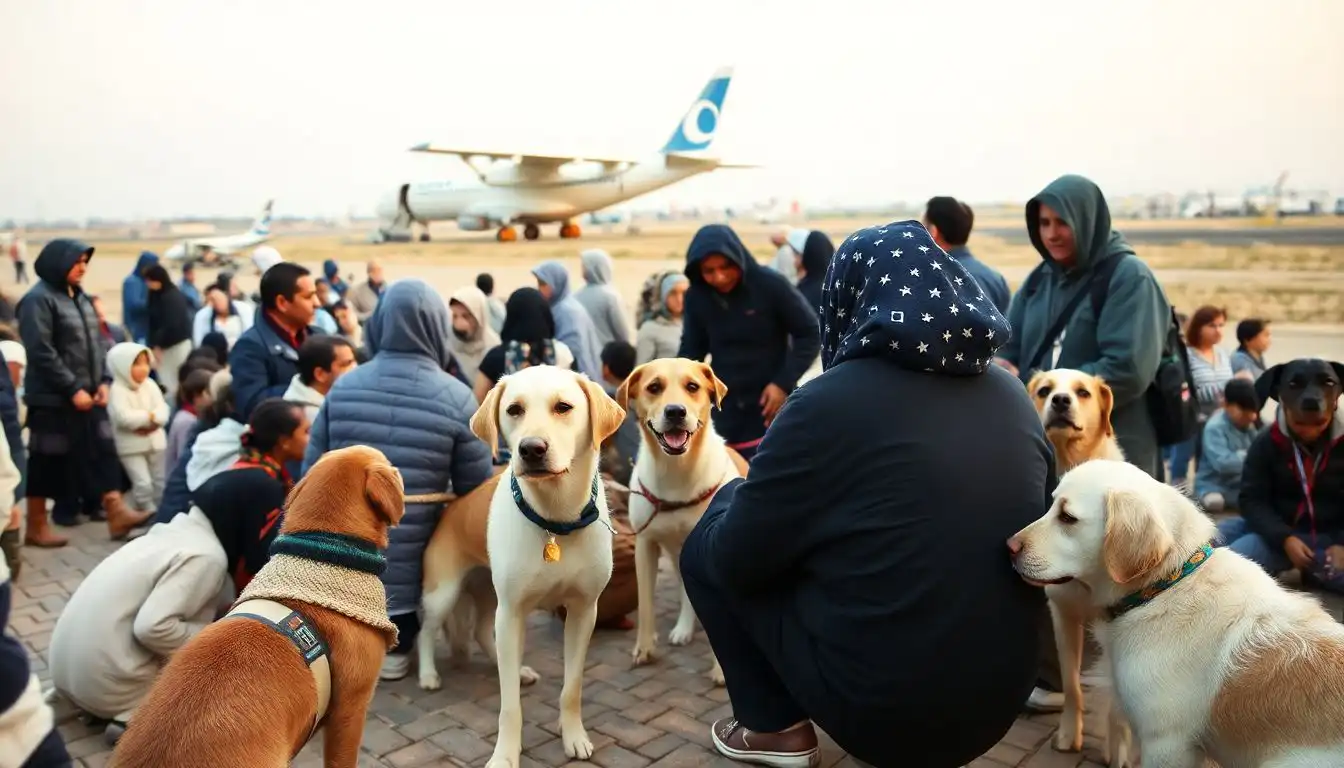
Special Flight from Abu Dhabi Brings 101 Greeks & 45 Pets Home: An extraordinary journey recently concluded as a chartered aircraft touched down, ending a long period of uncertainty for a large group of European nationals. This massive logistical undertaking saw over one hundred people and nearly four dozen animals safely transported across continents during a time of significant travel complexity.
The operation highlights the lengths to which community groups and private organisers will go to reunite families. For the 101 Greek citizens and their 45 furry companions, the arrival at their destination represented more than just a landing; it was a homecoming filled with relief and emotional reunions.
A Massive Logistical Feat in Local Aviation
Organising a private charter of this scale requires months of planning and significant financial backing. When commercial routes become unreliable or restrictive regarding animal transport, many travellers find themselves stranded in transit hubs like Abu Dhabi.
This specific flight was unique because of the high ratio of animals to humans. Usually, airlines limit the number of pets allowed in the cabin or the hold, but this mission prioritised keeping families together, ensuring that no dog or cat was left behind.
- I’m 37 and I Just Realized I’ve Been Calling Myself an Introvert for Twenty Years When the Truth is I’m Just Exhausted From Spending My Entire Life Accommodating Other People’s Need for Constant Noise
- Psychology says the parents whose adult children gradually stop visiting aren’t usually the ones who were cruel or absent — they’re often the ones so focused on providing and protecting that they never learned to simply be company, and children grow up moving towards the people they feel easy with rather than the people they owe the most to
- When someone is outwardly cheerful but still feels deeply alone, psychologists say these 10 quiet behaviors often reveal the disconnect
- If You Want To Find True Inner Peace, Start Saying “no” to These 8 Things
- I’m 65 and the most frightening thing about losing my joy wasn’t losing it — it was how long it took me to notice it was gone, like a light that dims so slowly you keep thinking the room is fine until one day you can’t read anything anymore
The cost of such an operation is often shared among the passengers, with prices frequently quoted in thousands of Australian Dollars (AUD) per seat. Despite the heavy price tag, the demand for these “pet-friendly” repatriation flights continues to grow globally as people refuse to relocate without their companions.
The Middle Eastern Connection
Abu Dhabi serves as one of the world’s busiest transit points, connecting the East and the West. For these Greek nationals, many of whom were working abroad or finishing long-term stays, the city became a temporary base while they waited for a viable way to return to Europe.
Navigating the customs and quarantine regulations of the United Arab Emirates is no small task. Every animal required specific health certifications, vaccinations, and export permits before they could even set paw on the aircraft.
The complexity of moving nearly fifty animals simultaneously cannot be overstated. From temperature-controlled holds to specialised crates, the engineering and biological requirements for a safe flight are rigorous, requiring expert oversight at every stage of the journey.
Also Read
- Goodbye to Low Pension Payments: Australians Could Receive Over $1,178 From 1 April 2026
- Psychology says the reason most people never change their lives isn’t fear of failure – it’s that they’ve spent so long performing a version of themselves for other people that they genuinely can’t tell anymore which desires are actually theirs
- Psychology says people who grow apart from their family as they age aren’t cold or ungrateful – they’re often the ones who finally stopped performing a version of themselves that kept the peace but cost them their identity
- I bought my grandparents’ house and lived next to my mom. When she decided to move, it was hard on both of us.
- Psychology says the quiet rage many older men carry isn’t bitterness, it’s the accumulation of decades where expressing vulnerability would have cost them everything — their authority, their marriages, their self-respect — so they stored it as anger because anger was the only emotion their generation allowed men to keep
Flight Statistics and Passenger Breakdown
To understand the scale of this mission, one must look at the data behind the manifest. The flight was not just a passenger jet but a carefully balanced ecosystem of humans and animals living in close quarters for several hours.
| Category | Total Number | Details |
|---|---|---|
| Human Passengers | 101 | Adults, children, and elderly citizens |
| Canine Passengers | 32 | Various breeds from Labradors to Terriers |
| Feline Passengers | 13 | Primarily domestic shorthairs |
| Flight Duration | 7.5 Hours | Direct transit from Abu Dhabi |
| Total Cargo Weight | 4.2 Tonnes | Including luggage and animal transport crates |
Overcoming Domestic Travel Barriers
Many passengers on this flight compared their experience to the difficulties faced by those trying to move pets into Australia. While this specific flight was headed to Greece, the hurdles regarding biosecurity and airline pet policies are a universal struggle for the “ex-pat” community.
In the Australian context, bringing a pet home involves months of quarantine and strict “rabies-free” documentation. These Greek travellers faced similar, albeit slightly more relaxed, European Union regulations, which still required meticulous paperwork to avoid the animals being impounded upon arrival.
The relief felt as the plane taxied to the gate was palpable. For many, the animals are not just pets but “fur babies” who provide essential emotional support during the stresses of international relocation.
- Psychologists say the bond between a person and the dog that sleeps in their bed isn’t comparable to human attachment. It’s actually more stable, because the dog never withdraws affection as punishment, never keeps score, and never makes closeness conditional on performance.
- Disability Pension Supplements of $1,600 Paid Before 1 April 2026 Nationwide
- Centrelink Digital Payment System From 1 April 2026: Faster Benefit Deposits For Australians
- $480 Medicare Safety Net Reset: New Threshold Applies From 1 April 2026
- Rent Assistance for Pensioners Climbs to $188.20 per Fortnight in 1 April 2026
The Role of Community Funding
Without the collective bargaining power of a large group, a flight like this would be impossible. Private charters are incredibly expensive, often requiring a down payment that could buy a small unit in a regional Australian town.
By pooling their resources, these 101 individuals were able to book a wide-body aircraft. This allowed for enough space in the cargo hold to fit 45 oversized pet crates, which would typically be rejected by standard commercial carriers on the same route.
When communities face systemic barriers in the travel industry, they often turn to grassroots organisation. These flights represent a shift toward decentralised travel, where the passengers dictate the cargo and the schedule rather than the airline.
Pet Safety and Welfare During Transit
The welfare of the 45 animals was the top priority for the flight crew and the organisers. Veterinary professionals were reportedly consulted during the boarding process to ensure every dog and cat was fit for the journey.
- I’m 37 and I Just Realized I’ve Been Calling Myself an Introvert for Twenty Years When the Truth is I’m Just Exhausted From Spending My Entire Life Accommodating Other People’s Need for Constant Noise
- Psychology says the parents whose adult children gradually stop visiting aren’t usually the ones who were cruel or absent — they’re often the ones so focused on providing and protecting that they never learned to simply be company, and children grow up moving towards the people they feel easy with rather than the people they owe the most to
- When someone is outwardly cheerful but still feels deeply alone, psychologists say these 10 quiet behaviors often reveal the disconnect
- If You Want To Find True Inner Peace, Start Saying “no” to These 8 Things
- I’m 65 and the most frightening thing about losing my joy wasn’t losing it — it was how long it took me to notice it was gone, like a light that dims so slowly you keep thinking the room is fine until one day you can’t read anything anymore
Unlike standard cargo, which remains stationary, live animals require specific airflow and pressure settings. Modern aircraft are equipped to handle this, but having 45 animals on a single flight pushes the limits of standard environmental control systems.
Fortunately, the flight reported no incidents. The pets arrived in Athens healthy, though likely a bit thirsty and confused by the sudden change in climate from the humid Middle East to the Mediterranean breeze.
The Emotional Toll of Separation
Many of the passengers had been separated from their wider families for years due to global travel restrictions. Adding the stress of potentially leaving a pet behind creates a mental health burden that is often overlooked in traditional news cycles.
Returning home is a significant life event that marks the end of one chapter and the beginning of another. For these Greeks, having their animals by their side made the transition back to local life much smoother and more joyous.
- Goodbye to Low Pension Payments: Australians Could Receive Over $1,178 From 1 April 2026
- Psychology says the reason most people never change their lives isn’t fear of failure – it’s that they’ve spent so long performing a version of themselves for other people that they genuinely can’t tell anymore which desires are actually theirs
- Psychology says people who grow apart from their family as they age aren’t cold or ungrateful – they’re often the ones who finally stopped performing a version of themselves that kept the peace but cost them their identity
- I bought my grandparents’ house and lived next to my mom. When she decided to move, it was hard on both of us.
- Psychology says the quiet rage many older men carry isn’t bitterness, it’s the accumulation of decades where expressing vulnerability would have cost them everything — their authority, their marriages, their self-respect — so they stored it as anger because anger was the only emotion their generation allowed men to keep
The successful landing serves as a blueprint for other groups around the world. It proves that with enough coordination, even the most difficult travel hurdles can be cleared to bring families—of all species—back together.
Observation suggests that the bond between humans and their pets has strengthened significantly over the last few years. Travellers are now more likely to delay their own relocation rather than travel without their animals.
Future of Special Charter Services
As the world continues to move away from the rigid structures of the past, specialized charter services are becoming a more common sight. We are seeing a rise in “inclusive” travel where the needs of the passenger and their dependents are put first.
While these flights are currently a luxury for those who can afford the high ticket prices, the increasing frequency of these missions might eventually drive down costs through competition. This would be a welcome change for people moving between hubs like Sydney, London, and Abu Dhabi.
- Psychologists say the bond between a person and the dog that sleeps in their bed isn’t comparable to human attachment. It’s actually more stable, because the dog never withdraws affection as punishment, never keeps score, and never makes closeness conditional on performance.
- Disability Pension Supplements of $1,600 Paid Before 1 April 2026 Nationwide
- Centrelink Digital Payment System From 1 April 2026: Faster Benefit Deposits For Australians
- $480 Medicare Safety Net Reset: New Threshold Applies From 1 April 2026
- Rent Assistance for Pensioners Climbs to $188.20 per Fortnight in 1 April 2026
For now, the story of the 101 Greeks and their 45 pets remains a heartwarming example of what can be achieved through determination and collective action. It is a story of resilience that resonates with anyone who has ever had to navigate the red tape of international travel.
FAQs – Special Flight from Abu Dhabi Brings 101 Greeks & 45 Pets Home
Why was a special charter flight needed for this journey?
Standard commercial airlines often have strict limits on the number of pets allowed per flight. With 45 animals needing transport, a private charter was the only way to ensure all pets could travel on the same day as their owners.
How do pets travel on large charter flights?
Pets typically travel in the aircraft’s hold within IATA-approved crates. This area is climate-controlled and pressurised to the same levels as the passenger cabin to ensure the animals remain safe and comfortable throughout the trip.
What are the main costs involved in a repatriation flight?
Costs include the aircraft rental, fuel, landing fees, ground handling, and specialised services for animal loading. When divided among 101 people, the cost is manageable but still significantly higher than a standard economy ticket.
- I’m 37 and I Just Realized I’ve Been Calling Myself an Introvert for Twenty Years When the Truth is I’m Just Exhausted From Spending My Entire Life Accommodating Other People’s Need for Constant Noise
- Psychology says the parents whose adult children gradually stop visiting aren’t usually the ones who were cruel or absent — they’re often the ones so focused on providing and protecting that they never learned to simply be company, and children grow up moving towards the people they feel easy with rather than the people they owe the most to
- When someone is outwardly cheerful but still feels deeply alone, psychologists say these 10 quiet behaviors often reveal the disconnect
- If You Want To Find True Inner Peace, Start Saying “no” to These 8 Things
- I’m 65 and the most frightening thing about losing my joy wasn’t losing it — it was how long it took me to notice it was gone, like a light that dims so slowly you keep thinking the room is fine until one day you can’t read anything anymore
Do the pets have to go into quarantine upon arrival?
Quarantine requirements depend on the destination country’s laws. For Greece, pets usually need a valid pet passport, proof of rabies vaccination, and a microchip, but they often avoid long quarantine periods if they come from a “listed” country like the UAE.
Can these types of flights be organised for Australians?
Yes, similar private charters have been organised for Australians looking to bring pets home from various international hubs. However, Australia’s biosecurity laws are much stricter, often requiring pets to stay in a government quarantine facility upon arrival.
What happens if a pet gets sick during the flight?
Flight crews are trained to monitor the cargo hold’s environment. While they cannot access the hold during many flights, they ensure the temperature and oxygen levels are optimal. Most pet owners also consult vets for mild sedatives or hydration snacks before departure.
How long does it take to plan a mission like this?
A mission involving over 100 people and 45 animals usually takes three to six months of planning. This includes securing the aircraft, verifying all health documents for the pets, and coordinating with airport authorities in both cities.